Hosted by Deeper Currents — field notes from the Middle Fork Nooksack River, June 28, 2026
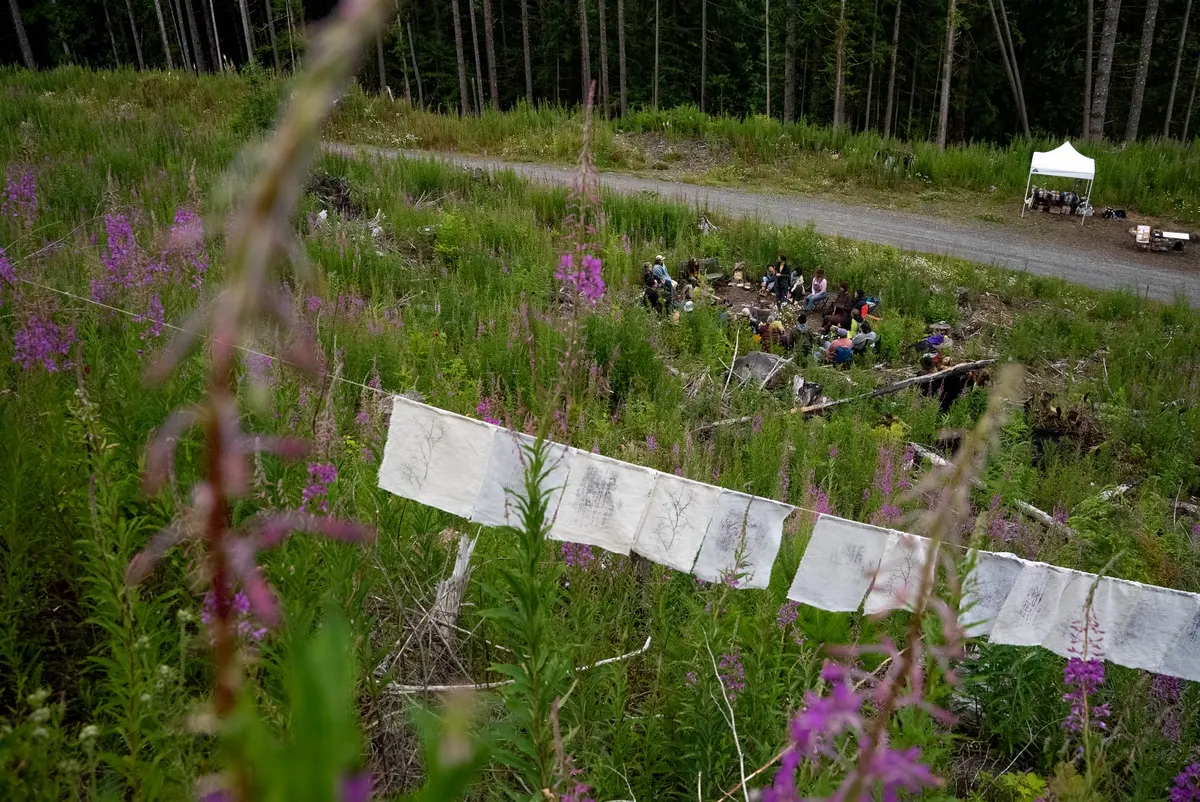
Before the ceremony began, someone had already laid three sheets of paper on a table beneath a white canopy: Portraits in Sawdust, testimonies written in wake of the clearcut. People read them quietly, standing in a rough circle where the ceremony would later happen — a small act of documentation that felt, even before anything formal started, like the whole point.
I came as a documentarian. I told people that plainly. Then I did what a documentarian does: walked the site, took stills, listened to fragments of conversation about the river, about this particular stretch of forest that used to stand here. It struck me, watching people read those testimonies aloud, how much documentation can shape what a place is remembered as. That felt like the job, suddenly, in a way it hadn't fully before.
The ceremony itself was called Tending Grief — for the former Box of Rain forest, along Clearwater Creek, on the Middle Fork Nooksack. About thirty people gathered on the far side of Clearwater Creek Road, under a line of memorial strips hung above the circle. A land acknowledgment opened the space, naming these as ancestral homelands. Someone spoke about the Global Earth Exchange, about reverence and joy as a discipline in radical times, about being part of something global even while standing in one very specific place.
A small tree stood over the bank. Someone said the words vigilance and care, back to back, like they belonged together. One voice in the circle talked about collectively holding the rights of nature — not owning them, holding them, the distinction doing a lot of work in one sentence.
Then the water offering: each person carried water from a place that mattered to them, and gave it back to the circle, one at a time. Thirty small tributaries, if you want to think of it that way. Someone asked a question that's stayed with me since: does water pay tribute to other waters? I don't know the answer. I'm not sure the question wants one.
The creek kept making its noise the whole time, underneath everything else. At one point the clouds lifted just enough to show the face of North Twin Sister, then closed back over it, like the mountain had only meant to check in.
And then, partway through the grief work — the meditation, the stone offerings — gunfire. AR-15 fire, somewhere close enough to hear clearly, cutting through a ceremony built entirely around slowness and tending. I don't know exactly where it came from or why. I know what it did in the moment: it made the air feel different. It put something hard and modern and violent directly next to something people were trying to hold gently. I wrote one word in my notes, right then: violence. Under it: police state. I'm not certain that's literally what it was. I'm certain that's what it felt like — standing in a circle built for grief, while something designed for a different kind of finality kept going off nearby.
That juxtaposition might be the whole story. A group of people trying to practice reverence for a place the Washington State DNR decided to cut down — while, close enough to hear, something else entirely kept firing.
Documentation matters. It shapes how a place gets remembered. It's what thirty people standing in a circle by Clearwater Creek were doing, one water offering at a time — building a memory of this place that doesn't depend on the clearcut being the last word.
Wil Henkel is an ethnohydrologist, filmmaker, and expedition kayaker examining how water and culture shape one another. His current work, The Living Nooksack River, is part of his MA thesis in Cultural Anthropology at Western Washington University, and picks up where his 2024 project Portraits in Sawdust (co-produced with Jericho Leavitt under Unevenground) left off, following the river's story downstream to the Salish Sea.